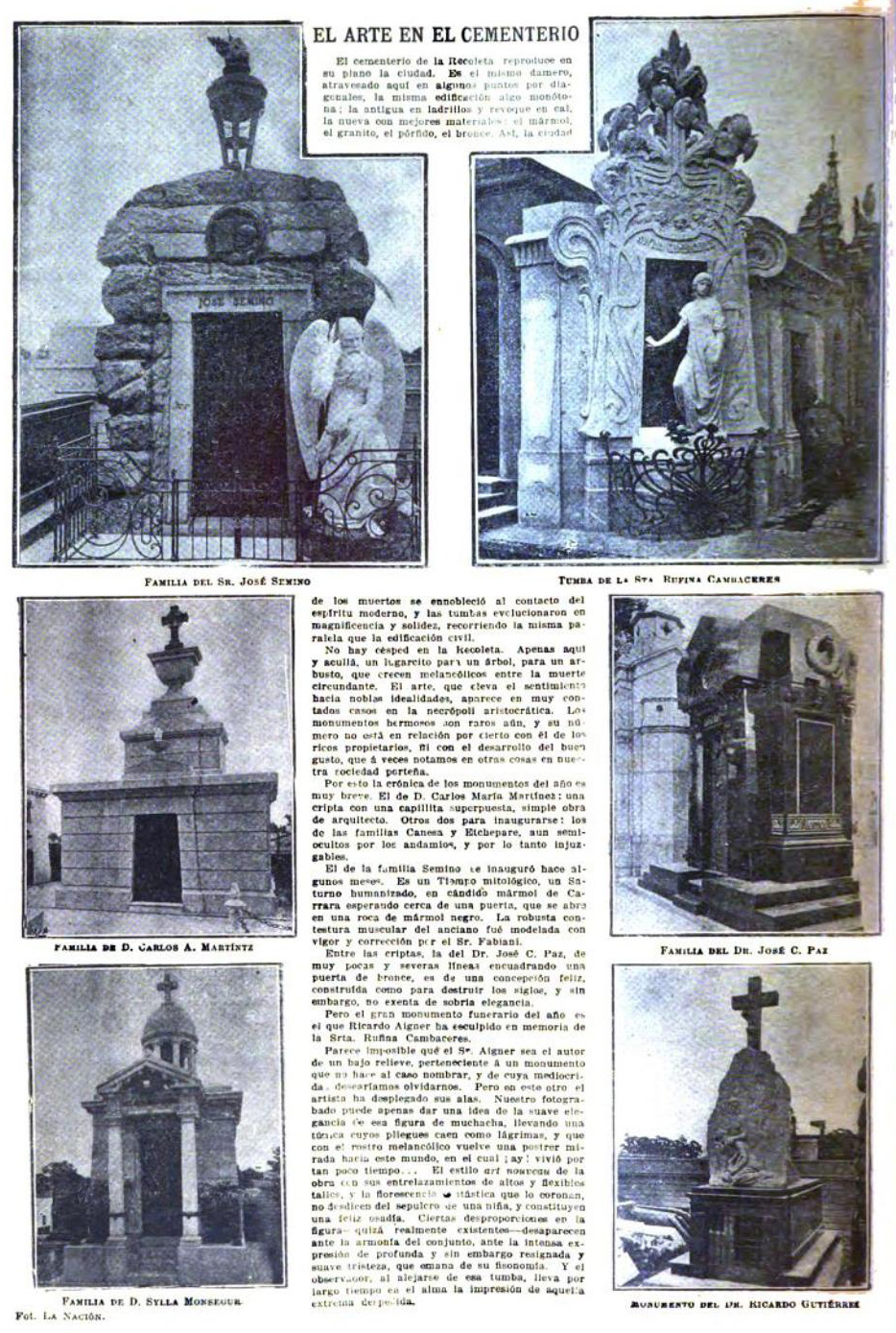
The above page is from the illustrated supplement of La Nación, published just before All Saints’ Day or Día de los Difuntos (Año II, Nº 61, 29 oct 1903). At the turn of the 20th century, Recoleta Cemetery had yet to become the fabulous outdoor art gallery that it is today… in fact, local critics were harsh & perhaps motivated families to up their game. Translation of the text follows:
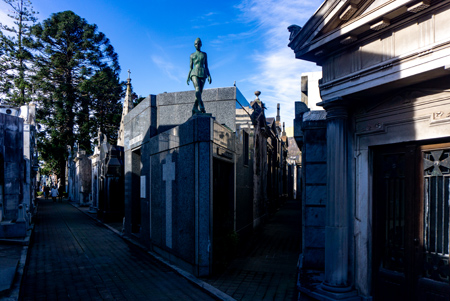
Recoleta Cemetery reproduces the city in its layout. It is the same checkerboard, crossed at some points by diagonals, the same, somewhat monotonous structures; the old ones in brick and lime plaster, the new ones with better materials: marble, granite, porphiry, bronze. Thus, the city of the dead was ennobled by contact with the modern spirit, and the tombs evolved in magnificence and solidity, following the same parallel as civil buildings.
There is no grass in Recoleta. Just here and there, a little place for a tree, for a bush, which grow melancholically among surrounding death. Art, which uplifts sentiment toward noble ideals, appears in very few cases in the aristocratic necropolis. Beautiful monuments are still rare, and their number is certainly not in relation to that of the rich owners, nor to the development of good taste, which we sometimes notice in other aspects of our society in Buenos Aires.
For this reason, this year’s chronicle of monuments is very brief. That of D. Carlos Marín Martínez: a crypt with a small chapel superimposed, a simple work of an architect. Two others are to be inaugurated: those of the Canesa and Etchepare families, still half hidden by scaffolding, and therefore unable to be judged.
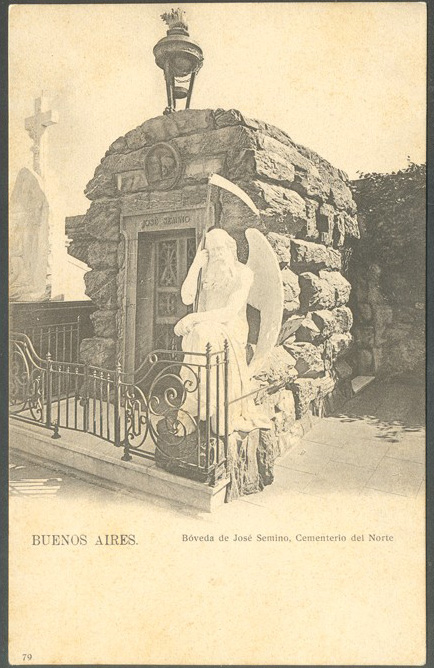
That of the Semino family was inaugurated a few months ago. It is a mythological version of Time, a humanized Saturn, in white Carrara marble waiting near a door, which rests on a piece of black marble. The robust, muscular build of the old man was modeled with vigor and skill by Mr. Fabiani.
Among the crypts, that of Dr. José C. Paz, with very few and severe lines framing a bronze door, is of good conception, built as if to destroy the centuries, and yet, not lacking in sober elegance.
But the great funerary monument of the year is the one that Ricardo Aigner has sculpted in memory of Miss Rufina Cambaceres.
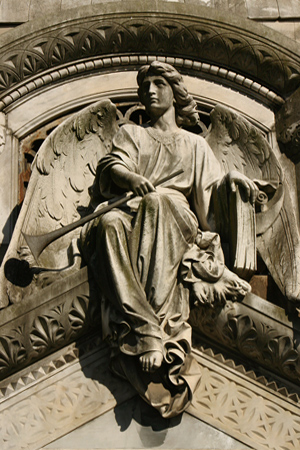
It seems impossible that Mr. Aigner is the author of a bas-relief, belonging to a monument that is not worth mentioning, and whose mediocrity he would like us to forget. But in this one, the artist has spread his wings. Our photograph can barely give an idea of the soft elegance of that girl’s figure, wearing a tunic whose folds fall like tears, and who with a melancholic face turns a last glance towards this world, in which, alas! she lived for such a short time… The art nouveau style of the work with its interlacing of tall and flexible stems, and the fantastic flowers that crown it, do not detract from the tomb of a girl, and constitute a happy daring. Certain disproportions in the figure —perhaps actually existing— disappear before the harmony of the whole, before the intense expression of profound and yet resigned and gentle sadness that emanates from its features. And the observer, upon leaving this tomb, carries for a long time in his soul the impression of that extreme farewell.
This brief text brings up many points to consider…
The comparison of the cemetery to a miniature city had already been established almost 125 years ago.
Apparently La Nación evaluated new additions to the cemetery in previous years, but I haven’t found earlier issues online. Yet.
Genoan sculptor Federico Fabiani established himself as a master of funerary art with other works in Caracas & in the city of Rosario. I wonder how the Semino family heard of him, & more importantly, where did that gorgeous statue end up? The tomb of boxer Luis Ángel Firpo now sits where José Semino placed the sculpture of Father Time/Saturn.
The brilliant 1904 sculpture by Jules Felix Coutan on the José C. Paz tomb had yet to be added when this article appeared. Was it in the works already, or did this criticism spur a fancy addition?
What mediocre bas-relief by Richard Aigner does the author refer to? The only other work by Aigner in Buenos Aires I can find is a statue of Germán Burmeister commissioned many years later in 1929. Any ideas?
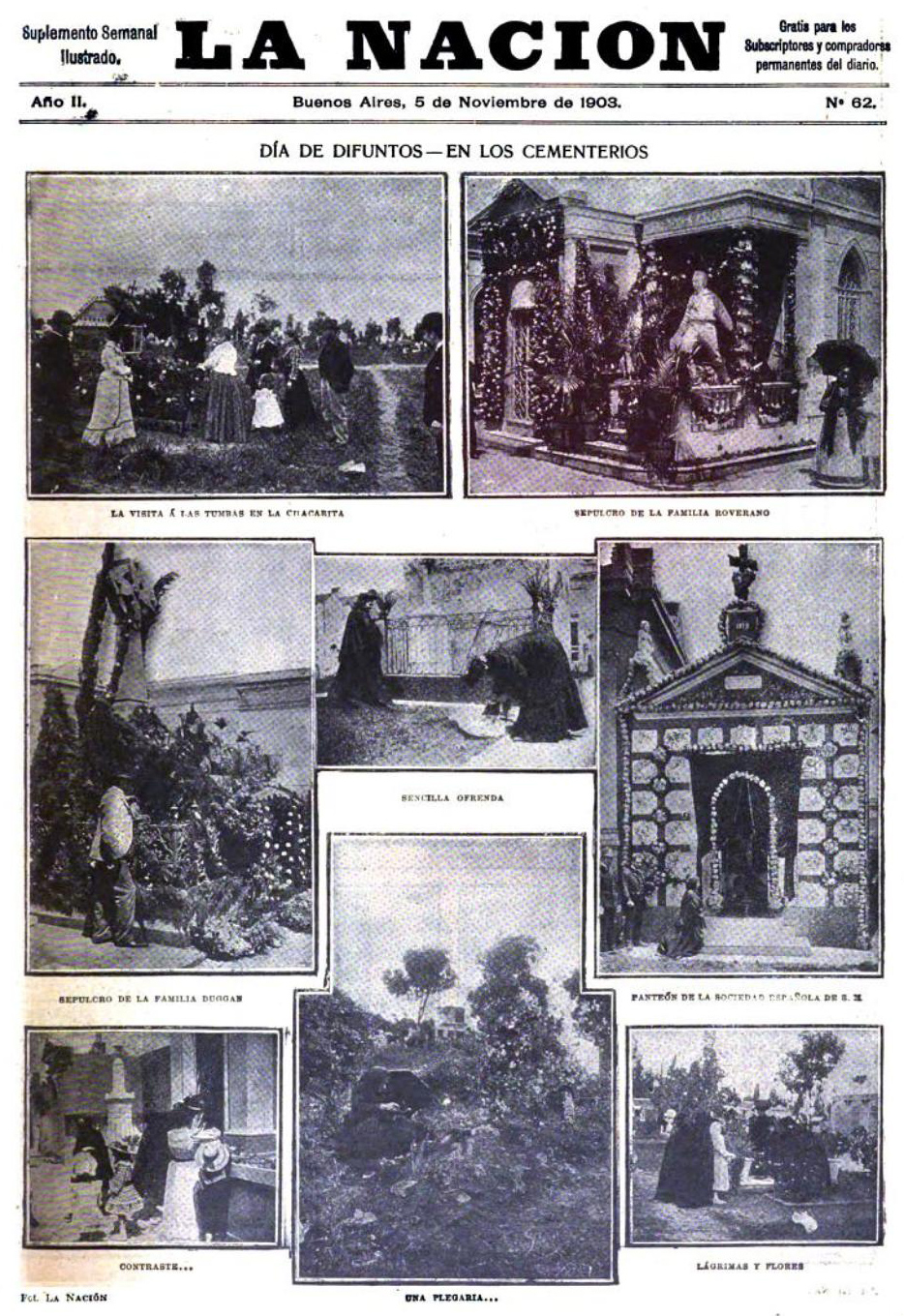
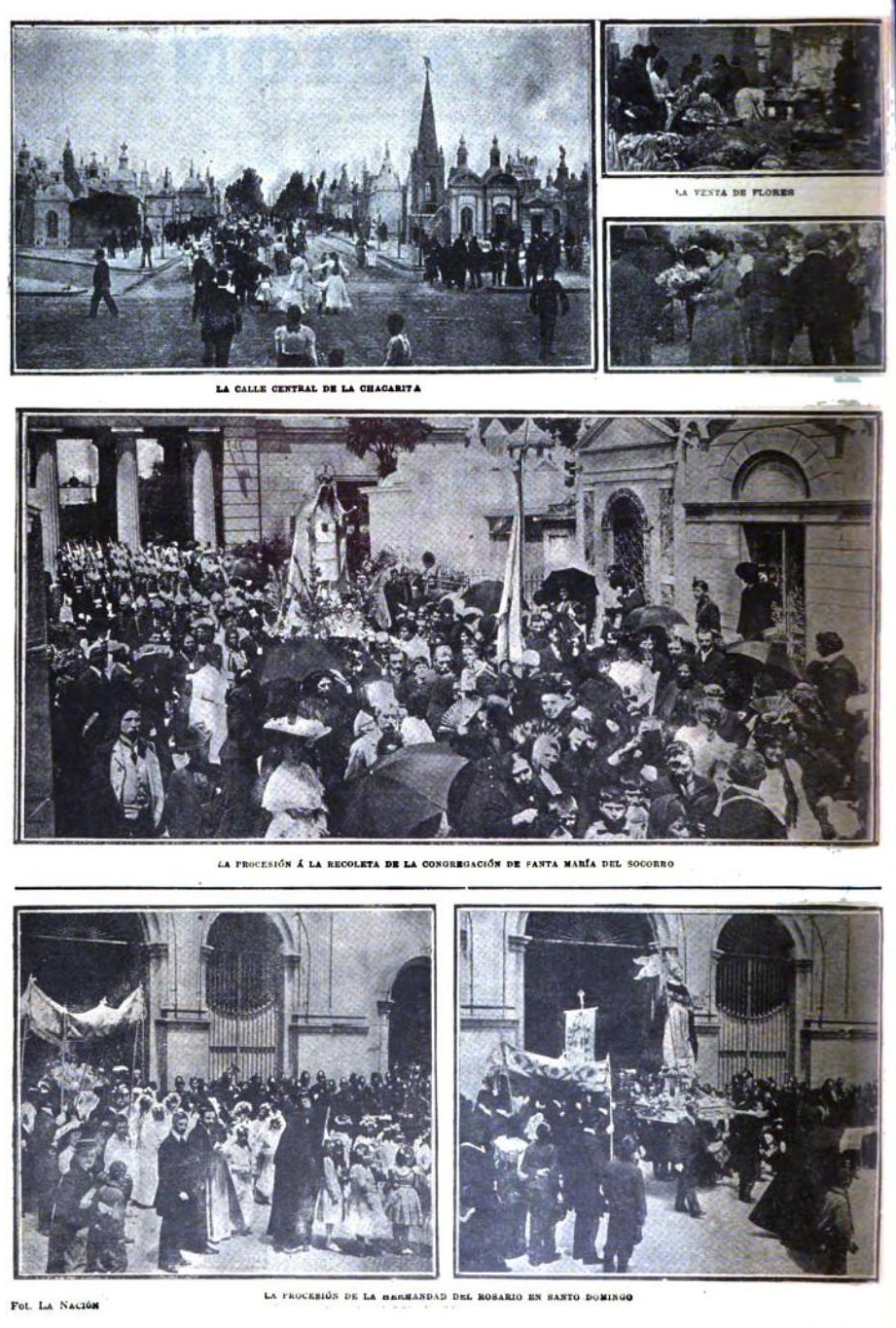
The next edition of the supplement (Año II, Nº 62, 05 nov 1903) shows the festivities for All Saints’ Day. Traditions have certainly changed because no one decorates their family mausoleum like this nowadays. A procession of Santa María del Socorro (from nearby Retiro) even took place inside the cemetery!
This post serves as a perfect example of why we’ve researched Recoleta Cemetery for almost 20 years: there’s always something interesting to uncover… which often leads to even more questions!
Update (04 Jul 2025): Marcelo found another group of images depicting All Saints’ Day —the last two are of Recoleta Cemetery— in the Buenos Aires society magazine Caras y Caretas from 10 Nov 1906:
Magazine text & images were scanned by Google Books. Postcard photograph of the José Semino mausoleum by Harry Grant Olds, listed in Centro de Investigación Fotográfico Histórico Argentino. Both in public domain.
Over the lifetime of this blog, we’ve seen a few vaults appear for sale online… but it isn’t common. Availability is low, transfer of titles takes time, & real estate agencies can lack experience dealing with this kind of transaction. However, more vaults than ever before have become available recently.
A perfect example is the Eugenio Mattaldi family vault, placed for sale in 2023 by his great-granddaughter. María Cristina Mattaldi works as a real estate agent, so she has the inside scoop. Her family vault stands alone, occupying the totality of its lot, which increases the value… as does its location: along the back row of the cemetery near many important historical figures like President Manuel Quintana or close to striking sculptures by Troiano Troiani on the Familia Manuel Cerini vault.
The Mattaldi vault sits on 20 square meters with its own beautiful sculpture, another big selling point (above photo). The structure has three levels: a ground floor, a first and second basement, as well as a chapel with stained glass windows and marble stairs. All that space allows storage for 30 coffins. Transfer of the deed would be through prescriptive acquisition or usucaption… basically occupying the spot with permission of the original owners.
This raises an interesting point about land use in Recoleta Cemetery: the lot itself belongs to the city government, but the family has been given permission for perpetual use. For the price of 95,000 USD, María will transfer all rights + the entire structure. Prospective buyers have to figure about 30 USD for monthly maintenance fees as well.
Sidenote: The cyclic nature of the Argentine economy could be one factor in these specific properties appearing on the market. I remember in the aftermath of the December 2001 devaluation, everyone wanted cold, hard cash. The owner of our rental apartment offered it to us for the incredible price of 47,000 USD. When I left Argentina in 2015, it was worth 250,000 USD… too bad I didn’t buy then!
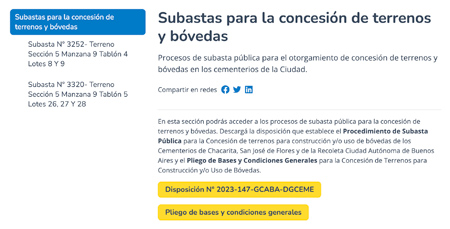
Of course, grand mausoleums like that of Mattaldi are rare opportunities. For the rest of us who might want a chance to socialize in the afterlife with Argentine elite, a recent development has made burial in Recoleta Cemetery more accessible. In September 2024, public auctions for vaults will take place for the first time in 57 years.
Banco Ciudad has a section on their website with all the legalese & starting bid prices. This might become more common as a way to restore historic properties & keep them in good condition… not only for Recoleta, but also for all other cemeteries in Buenos Aires. Concessions are given for 60 to 99 years, depending on the condition of the vault or lot up for auction.
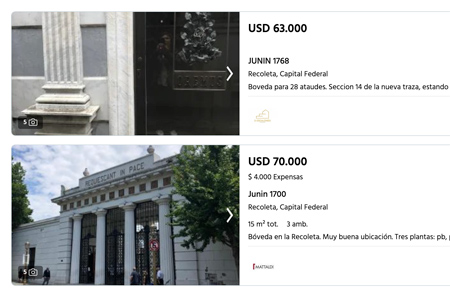
Even real estate websites like Zonaprop have taken to listing vaults… as of the publication of this post, two were available at the average price of 67,000 USD. What are you waiting for??
Years can pass without much happening in Recoleta Cemetery, but 2024 seems special with lots of research & investigations taking place. I don’t think I’ve ever had to post two newspaper articles back to back! Below is the translation of an article published on 02 Aug this year by the media outlet Infobae (original link in Spanish is here).
The vault that holds the remains of Camila O’Gorman in Recoleta Cemetery is opened for identification
Pilar O’Gorman, great-great-great grandniece of the young woman who had a deep love for the priest Uladislao Gutiérrez and who she was shot with in 1848, fights for the family vault to be declared as a historical heritage site. The poor state of the crypt, which is in danger of collapsing. And why the Archbishop of Buenos Aires, Jorge García Cuerva, was present at the event.
By Hugo Martín
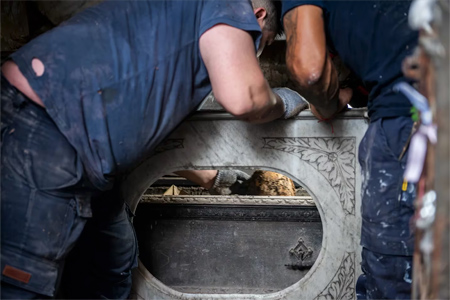
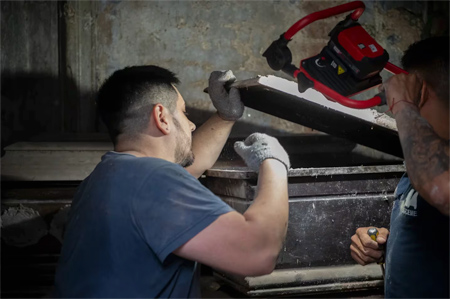
Two employees of Recoleta Cemetery open an urn in the O’Gorman family vault (Jaime Olivos)
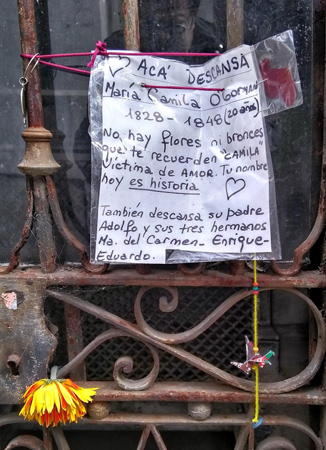
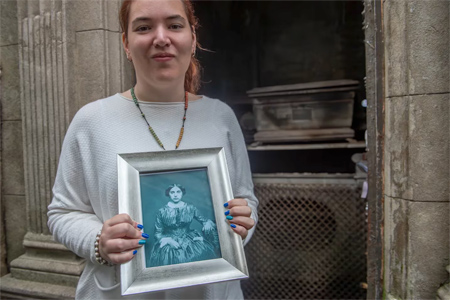
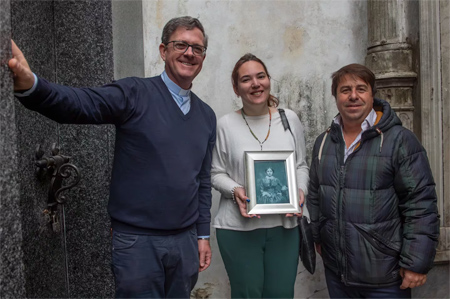
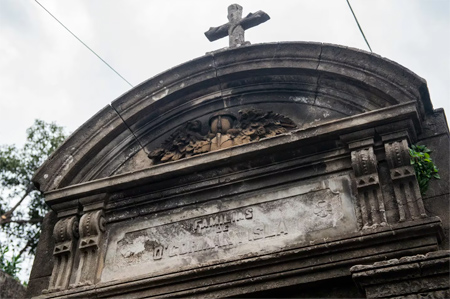
Pilar O’Gorman waits by the rickety iron door of a crypt. In her hands she holds a framed portrait of Camila O’Gorman. She is 30 years old & is her great-great-great grandniece. Seven generations ago on August 18, 1848, her predecessor, that young woman from Buenos Aires society who fell in love with the priest Uladislao Gutiérrez, was shot alongside him. The story became popular in the 1980s, when that impossible romance was made into a movie: Camila. But now it is 11:30 on the humid & gray morning of August 1st, & the setting is Recoleta Cemetery. Above the entrance to the vault it reads, verbatim: “Families of O’Gorman and Isla”. The Islas, explains Pilar, “are a family of the Buenos Aires bourgeoisie, politicians. A daughter of Enrique, Camila’s brother from whom I am descended, married an Isla.” The entrance is sealed with a padlock. Pilar says that the father of a well-known writer placed it there, he left the key with the cemetery’s administration & that it was lost. A few weeks ago they tried several, without luck. Everything is neglected: the glass on the door is broken, dirty and covered in cobwebs. Only white ribbons that people leave remain tied to the wrought-iron. As with the tomb of Felicitas Guerrero, it is a way to honor two young women who lived through a tragic love affair.
The vault opens
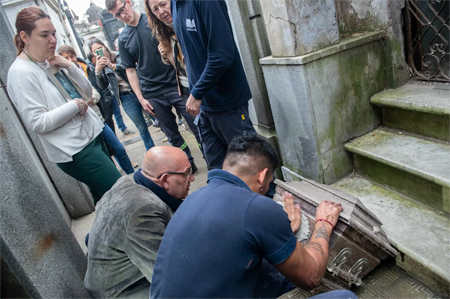
Ten minutes later, a cemetery employee arrives at the small dead-end street (No. 3 in Sector 9, near the entrance), which faces the wall on Junín Street, with a circular saw. He unscrews a white rosary that is attached to the padlock. He gently sets it aside. And then, with speed and precision, he takes the tool and breaks the bolt. A few sparks and the doors, crowned by a semicircular iron arch, creak open.
Pilar O’Gorman, great-great-great grandniece of Camila O’Gorman, with her portrait, fights for the vault to be recognized & declared as a historical heritage site (Jaime Olivos)
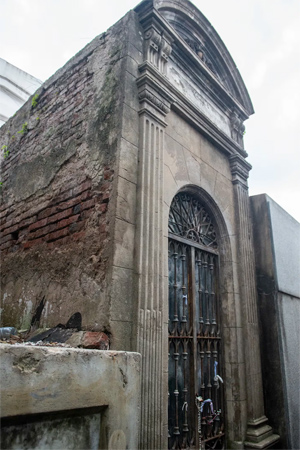
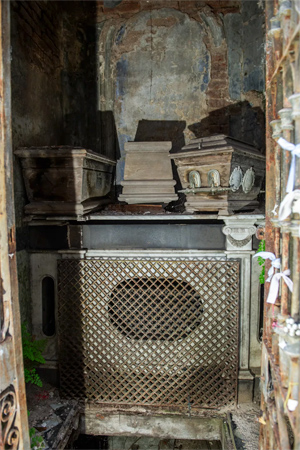
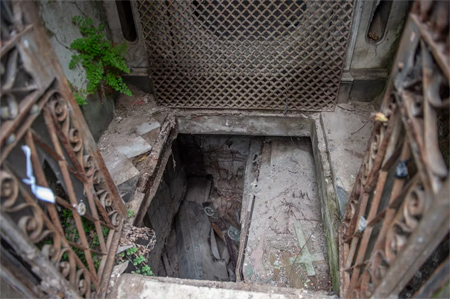
Inside, the deterioration in which it is found is depressing. The place is small, no more than 2 meters wide & another two meters deep. The walls are peeling, the mud bricks of the old construction have cracks. Three urns covered in dust are piled up in front. One is turned upside down: if it were in the correct position, it would collapse and the ashes it contains would be scattered. There are no candles, flowers or candelabras. All of that was looted years ago. Below, there is only one underground level, which according to Gabriel Roldán and Alan Martínez, the employees who entered, can reach up to 9 meters in depth. They detected that there are 12 “catres”, the name of the structures that support the drawers. However, they could not descend. They immediately noticed that the structure was moving. The risk of everything collapsing is visible to the naked eye . The back wall has a hole, & from another collapse on the left side, a coffin from a neighboring niche has entered into the O’Gorman vault & found crossed on the floor, about to break. Furthermore, according to the cemetery manager, Gustavo Rossi, an AYSA [the local water company] pipe, broken a few years ago, caused leaks that flooded and weakened the structural part of the crypt: “It is being fixed now.”
Inside the vault, with difficulty, covered in dust & cobwebs that stick to their blue sweater, Roldán and Martínez, illuminated by a halogen lamp, removed the urns. Another employee, Hector Cruz, wrote down the names in black ink. In the first there are four plaques, and inside, only ashes. There are those of María Teresa O’Gorman, who died on June 22, 1971; that of Paz Rodríguez de O’Gorman, who died on July 27, 1965; that of Ramona Rodríguez O’Gorman, whose death was on July 25th in the 1960s (the last number is illegible) and María de las N. de O’Gorman, who died on June 22, 1966. In the second urn —the one they removed upside down— only reads María G. de O’Gorman, RIP and a plaque says: Antonio O’Gorman 8/2/1912. The third urn contained two plaques referring to the same person: Adalberto J. O’Gorman, who died on June 9, 1938. They then removed a plaque from the shelf located above: Esther O’Gorman of Harrington, who died on September 2, 1977. And finally, the largest and heaviest urn —which they could not remove— and was located behind a piece of marble. They thought they would find remains of several ancestors, but the employees clarified that there was “a single skull .” That of Ernestina O’Gorman de Dhers, who died on May 29, 1957.
The vault, that is in danger of collapsing, says on its façade: “Familias O’Gorman y (sic) Isla” (Jaime Olivos)
According to historian Héctor Daniel De Arriba —who accompanies Pilar O’Gorman in her fight for the family vault to be restored and valued— the last time a dead person entered this crypt was in 1984, when the mother was buried by the notary public, Rafael ‘Yuyo’ O’Gorman. Pilar began her struggle almost alone that, for now, she is winning. At least she managed to open the crypt. “This vault is shared, & the other part of the family has the ownership title. They are my dad’s cousins. The title remained in the hands of Yuyo’s children, who moved to a private cemetery. I couldn’t tell you if the children are interested in all this or not, because when the file was opened & they were notified of the opening of the vault because it is in danger of collapsing, they did not respond. The law says that if there is a danger of collapse the cemetery has to act. Then, it will notify you again. If you do not answer, the cemetery can use the vault as a place of tourist interest. I couldn’t do much else. I hope Yuyo’s children answer. In any case, I am working with [the Ministry of] Culture, with the Buenos Aires Legislature for a patronage project, for the [corresponding] arrangements and & with the Senate so that the vault is declared a historical heritage site.”
But the road will be arduous. Rossi explains that, for cemetery management, “we dictated the abandonment of the vault, the family was advised & the procedures began to fix everything, due to the danger of collapse. That entire sector is closed. Only now were we able to open it, intervene & do the corresponding studies to be able to restore it. Once the vault is consolidated and rebuilt, within four or five months, the family is advised again to see if they want to pay for the repair. If you do not pay the settlement, the vault [ownership] expires, the City government keeps it and the remains are removed. But it is not so fast, justice also has to act. “We are doing it with several vaults that are in poor condition.”
Urns in the upper part of the crypt contain remains of family members who passed away in the 20th century (Jaime Olivos)
For now, Pilar knocks on all the doors she can to make her dream come true. “I think it’s good that the cemetery uses the vault as a point of tourist interest. And I work with them. For example, it was suggested to us if on August 18th, which is the date of the execution of Uladislao and Camila, we could hold an event here and tell their story. I told them yes, of course. I think it is important to work together so that their memory & name have a prominent place. They both went through their historical context & are personalities that touch us all.”
Also in the fight
However, today Pilar O’Gorman is no longer alone. With her, in the meager space of the internal street, in addition to De Arriba, her boyfriend Nicolás Laurnagaray (administrative assistant of the national Senate) & of course Rossi, were none other than the Archbishop of Buenos Aires Jorge García Cuerva; the head of advisors to the Senate, Agustina Tardieu; the general director of Cultural and Creative Development of the Ministry of Culture [of the city government], Carolina Cordero; another member of said team, Mercedes Urbonas Alvarez and the former head of the historical & artistic department of Recoleta Cemetery, Susana Gesualdi.
The underground part of the vault, with a coffin that was in a neighboring niche & entered due to structural collapse (Jaime Olivos)
The presence of the Archbishop of Buenos Aires was one that attracted the most attention. Monsignor García Cuerva explained to Infobae that his interest in the topic was “absolutely personal”, unrelated to his pastoral work. “I have a degree in Church History. My thesis at the Catholic University, which I defended in 2003, was on the yellow fever epidemic of 1871, where two of Camila’s brothers were protagonists. They were Enrique O’Gorman, chief of police, and Eduardo O’Gorman, who was a priest . Both worked very hard to move the city of Buenos Aires forward during the epidemic. But also, I did my thesis in Canon Law on cemeteries and funerals. Together with other residents of the city, we formed a self-convened group in defense of the historical heritage of cemeteries. They are open-air museums & we must take care of them, defend them & value them, because those who preceded us on the path of life rest here.”
Camila and Uladislao
A brief review of the life of Camila O’Gorman should highlight the most important parts of her brief existence. She was born on July 9, 1825. She was the daughter of Adolfo O’Gorman and Joaquina Ximénez Pinto. She went to mass at the Socorro parish, where she met the Tucumán priest Uladislado Gutiérrez. A passion grew between them that they did not want to stop. On December 12, 1847 they fled the city. When they arrived in Entre Ríos they did so with a false identity: Máximo Brandier and Valentina Desean. In Goya, Corrientes, they opened a school. There, Uladislao was recognized and both were arrested. On August 15, 1848, they were housed in the barracks of [Juan Manuel de] Rosas in Santos Lugares [known as the city of San Martín today, just outside the current city limits of Buenos Aires]. Juan Manuel de Rosas, who found out late about the escape, met with Camila’s father, who asked for exemplary punishment. Under pressure, on August 18th at dawn he signed the death sentence. Not even the pleas of Rosas’s daughter Manuelita, Camila’s friend, made him change his mind. At 10 in the morning, the two were shot. They were buried together under a willow tree.
The Archbishop of Buenos Aires, Jorge García Cuerva, Pilar O’Gorman & the manager of Recoleta Cemetery, Gustavo Rossi (Jaime Olivos)
For Archbishop García Cuerva, Camila O’Gorman’s relationship with the priest Uladislao “is a historical fact that should not be analyzed in an anachronistic way, it must be analyzed according to her era, where all the emphasis was placed on the decision Rosas made, but it has not been taken into account that the entire ruling class, including the opposition ruling class that emigrated to Uruguay, the Banda Oriental, demanded exemplary measures, that they be shot, because, they said, the city of Buenos Aires was too liberal. It was mere political opportunism of the ruling class, which unanimously demanded this tragic measure that, of course, is absolutely terrifying to us. But I insist, we must not analyze history in an anachronistic way. And yes, perhaps, rescue the figure of Manuelita Rosas, who as Camila’s friend, interceded for her until the last moment.”
The historian De Arribas intervened in the talk with the prelate & added: “The concubinage of priests was common at that time. Monsignor Elortondo y Palacios, deputy & director of the National Library, had his common-law wife. It was normal. The high ecclesiastical hierarchy had servants who were their concubines. Here what was reversed is that Camila belonged to high society and went with a provincial priest, from a parish far from the center of Buenos Aires. They inverted that relationship code and aggravated it, in a sense, by leaving Buenos Aires. And with an something extra: Uladislao took the alms from the Socorro parish, something that a representative of the Vatican reported & is in its secret archives.”
The opening of an urn in the O’Gorman family vault (Jaime Olivos)
The other myth of her escape and capture on June 14, 1848 in Goya, Corrientes, is that Camila was in an advanced state of pregnancy. “There is the report from Corrientes, where it appears she felt nauseous. Investigators said it was because she was pregnant. And then, well, as Monsignor says, the Unitarians applied political pressure & Rosas had to set an example of morality for women and men, & he had no choice but to punish her.”
Looking forward
When work on the vault was completed, it became clear that it will not be easy to determine in which shelf or urn Camila O’Gorman’s remains are. There is much to analyze underground in the crypt. One possibility would be to do a DNA study of the remains. As Carolina Cordero, who participated in the identification of remains of Falkland Islands soldiers, explains, “the best things to analyze are samples that are compared with direct lineage: fathers, mothers, brothers, cousins. Then, with the passing of generations, it begins to deteriorate a lot. You have to find DNA that has clean or uncontaminated genetic material, for example teeth or a femur. Furthermore, Camila had no descendants.” But nevertheless, she points out, there is something that would make her identification much easier: “If her bones are there, there are the bullet marks that Camila received when they shot her.”
Pilar drew an optimistic conclusion in the end: “We have been waiting a long time for this to happen. We expected this result, it would be difficult for Camila to be identified in a coffin, given the number of years that had passed. But having been able to open the mausoleum and for it to begin to be restored is a great step, a great vindication for Camila and Uladislao.”
Pilar O’Gorman & the historian Héctor De Arriba examine an urn (Jaime Olivos)
The historian De Arribas —who wrote Four Priests and One Woman: Camila O’Gorman (Editorial Dunken)— agrees with Pilar: “The expectations of opening the vault were fulfilled. Afterwards, the part of identification of the coffin or urn that had Camila’s remains was not, because the vault is very deep and, due to the date of her burial, she would be at the bottom, and those that we discovered above, were from the 20th century. There’s still a big unknown. But documents say that her remains were transferred from Palermo and buried here on September 3, 1952. For me, who is not an O’Gorman, but a historian, I am satisfied that Pilar managed to open the vault in her titanic battle., because other O’Gormans have told me ‘Camila is in the past’. And the story is not in the past. It helps us learn from it. This story that has its romantic overtones, that of a 23-year old girl who leaves with a 25-year old priest and they get pregnant, is more than that, it broke with the canons of patriarchy, control, the bishopric and Rosas, of course. They were brave. And I think they are happy in heaven.”
Just after noon, when almost everyone has said goodbye to Pilar O’Gorman, the cemetery manager places a new padlock on the door. The brand is D-10. Rossi —a man surely accustomed to the dark humor of those who work in the cemeteries— cannot avoid the joke: “Now they have God’s lock.” [Sports reference here: a #10 jersey belonged to Diego Maradona, who had an important goal nicknamed “the hand of God.” So God & 10 go together.]
The very poor condition of the O’Gorman family vault (Jaime Olivos)
Update (16 Jul 2025): And the search continues… here’s a recent article from the TN website.
Lautaro contacted me in December 2023 with questions for a newspaper article concerning the cemetery cats & what my time guiding in the cemetery was like. Little did I know he was preparing such an extensive investigation! I’ve copied the text & photos of the original piece below for posterity’s sake —this website has always been a repository for information about Recoleta Cemetery— but the original link is here.
While I always enjoyed my connections with those cats, they definitely deserved better lives. It’s comforting to know steps have been taken to make that happen…
The missing cemetery cats of Buenos Aires: What happened?
Famous tourist spot, the Recoleta Cemetery, once teemed with stray felines. But evolving notions of animal welfare brought big changes.
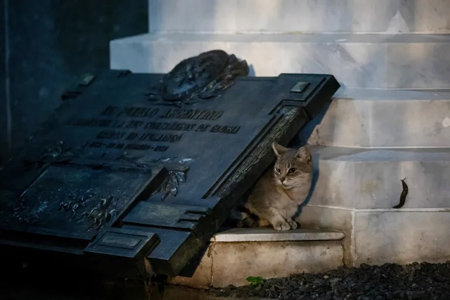
Grisecito, a stray cat in the Recoleta Cemetery, rests under the plaque of Carlos Federico de Brandsen, a French general who fought in several South American wars of independence [Maria Amasanti/Al Jazeera]
By Lautaro Grinspan 28 Jul 2024
Perhaps improbable for a bustling Latin American metropolis, one of the most well-known tourist attractions in the Argentinian capital of Buenos Aires is a graveyard.
The Recoleta Cemetery includes a maze of Art Nouveau and neo-Gothic marble mausoleums, the tomb of lionised former first lady Eva Peron – and a show-stealing colony of cats. For decades, tourist cameras strayed from the wrought-iron doors and sculpted Madonnas that decorate the graveyard’s sumptuous mausoleums and instead trailed the cats as they sauntered and sunbathed. The stray cats were the subject of a 2016 documentary. They were even recently brought up on the media tour of the latest Mad Max film, Furiosa, thanks to a nostalgic comment from the Argentina-raised movie star Anya Taylor-Joy.
The cemetery looms so large in visitors’ itineraries because of its architectural extravagance and its connection to the country’s elite. Nestled inside one of Buenos Aires’s poshest neighbourhoods, it’s the burial place of past presidents and assorted national heroes – a who’s who of Argentinian history, the necropolis edition. For as long as most locals can remember, the cats topped off the site’s grandeur with a touch of whimsy.
Sergio Capurso, a tour guide at the Recoleta Cemetery and the son of a former funeral services employee, said the place was “full of cats” in his first visits as a young child in the late 1970s. He has since seen scores of visitors fall for them during his tours.
One of those besotted tourists was Blake Kuhre, a visitor from the United States who would go on to create the Guardians of Recoleta documentary. Kuhre remembers that coming across “a top tourist attraction that was literally swarming with cats felt completely foreign. … You have this form of life that’s living in a place where everyone has gone to rest.”
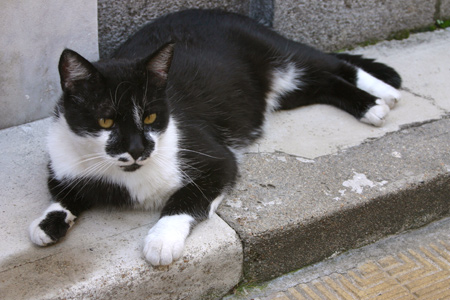
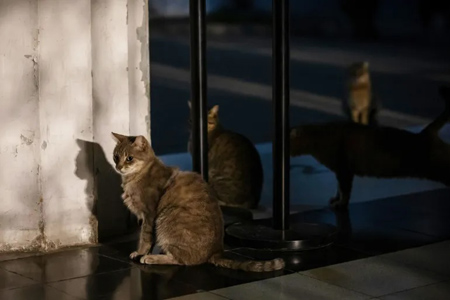
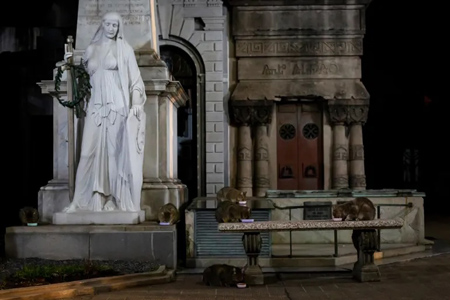
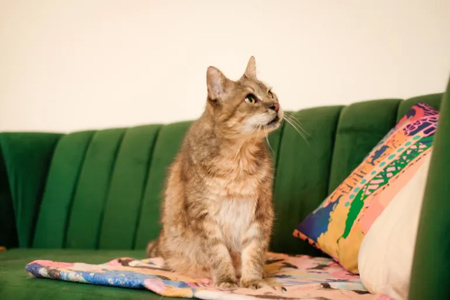
The six remaining cats in the Recoleta Cemetery – named Lili, Princesa, Llorona, Lucio, Cabezón and Grisecito – wait to be fed. There were once more than 60 strays [Maria Amasanti/Al Jazeera]
But things have changed.
In 2024, the thousands of visitors who stream through the peristyle at the entrance of the cemetery will struggle to spot the Recoleta felines. Their population went down from an estimated peak of more than 60 decades ago to just half a dozen today. That’s due to a recent and sometimes contentious adoption drive.
To cat welfare advocates, the new whiskers-less look of the Recoleta Cemetery is a sign of progress. No amount of fame and folklore, they say, makes up for the fact that stray cats have significantly shorter lifespans than those with indoor homes. But others lament that something was lost as more and more cats were moved away from the cemetery, taking some of the tourism hotspot’s mysticism with them.
“It was one of the things that people used to always expect as part of a visit to the Recoleta Cemetery,” said Robert Wright, a guide who worked for the well-known American travel writer Rick Steves for more than 20 years and who led tours in Recoleta from 2003 to 2015.
As communities from New York and California to France and New Zealand struggle to humanely contain surging populations of stray cats, Recoleta may not present much of a blueprint. The visibility that made the Recoleta cats so popular among cemetery-goers went a long way in helping them find adopted homes – some as far away as the US. But the story of Recoleta and the unravelling of a uniquely beloved stray cat colony could help more and more people see through the often misleading charm of urban fauna.
“People had this emotional, cultural attachment [to the cats]. And we try to explain to them that, actually, it’s a good thing that there are fewer cats around,” said Victoria Bembibre of Hace Feliz A Un Gato, a cat welfare group that looks after stray cats mostly at another Buenos Aires tourist attraction, the nearby botanical garden.
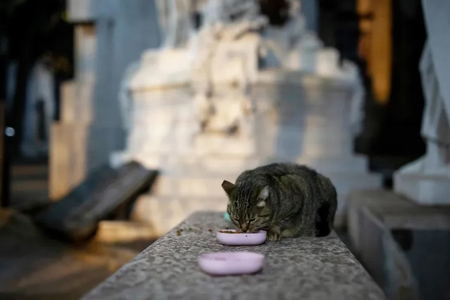
Llorona eats her first meal of the day. Marcelo Pisani, a local florist, visits the cemetery every day about 5:30am to feed the cats. In a country with an ever growing economic crisis and more than 250 percent inflation, Pisani is finding the cost of looking after the animals increasingly prohibitive and has become reliant on donations from visitors [Maria Amasanti/Al Jazeera]
Arturito, a stray cat from outside the cemetery, visits daily to benefit from Pisani’s feedings [Maria Amasanti/Al Jazeera]
Each of the places where outdoor cats cluster comes with its own set of hazards. Unlike most cemeteries, vegetation is scarce at the hyper-urban Recoleta. That means less shade for its cats and a high rate of cancers linked to sun exposure. And while most of the cemetery’s fancy mausoleums are well-maintained, a few have fallen into disrepair with broken glass leaving coffins exposed. Locals said some of the cats would sometimes fall into underground crypts and struggle to get out.
“In the past, I also may have thought, ‘Oh, how nice to see cats around.’ But that was when I didn’t understand how crude the reality is for any cat that lives outside,” Bembibre said.
The remaining Recoleta cats now mostly come out early in the morning and in the evening when the cemetery isn’t as crowded. They have become less accustomed to being around people since the cemetery’s pandemic closure – Argentina had one of the world’s longest COVID-19 lockdowns.
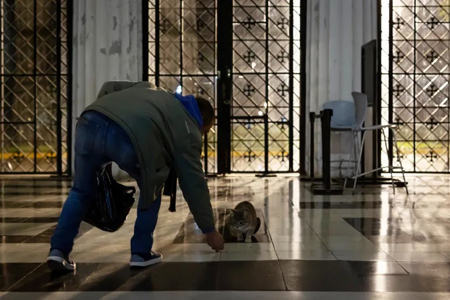
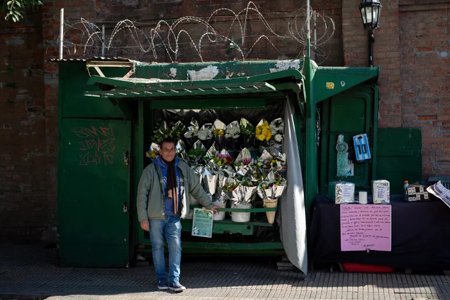
The cats’ current caretaker is Marcelo Pisani, 55, an animal-loving florist who runs a flower stand near Recoleta. He is allowed into the cemetery before it opens to tourists every day, usually about 5:30am, to put out food bowls.
“I take this very seriously, this matter with the cats. I’m always here for them. I never go out of town, not for Christmas, not for New Year’s,” he said. “And it doesn’t bother me. I dedicate my life to them.”
The Recoleta cats eat in front of the grave of General Miguel Estanislao Soler, a hero of the Argentinian War of Independence [Maria Amasanti/Al Jazeera]
‘There was a lot of tension’
Stray animals are a fixture of daily life across Latin American cities – sometimes to the surprise of international visitors. That’s partly because municipalities in the region play a minimal role in animal control and don’t typically fund public shelters. When locals want to let go of their pets, many have historically taken them to spots like the cemetery or the botanical garden. If those pets aren’t fixed, their population quickly swells.
In Buenos Aires, the Recoleta Cemetery cats were the face of a top tourist attraction, but their wellbeing always relied on the love and largesse of locals like Pisani.
Starting in the 1990s, a wealthy neighbourhood widow whose husband was interred in the cemetery took up the cats’ cause. She paid for daily feedings and regular flea treatments. Alongside cemetery management, the widow, Alicia Farias, resisted efforts to move the cats into adopted homes.
“There was a lot of tension. … They were afraid of losing the cats because they were part of the business. Tourists loved them,” said Alejandro Aranda Rickert, a local sculptor and painter who visited the cemetery every Sunday to sketch. Although Aranda Rickert enjoyed capturing the cemetery cats in drawings – his work was featured in a video about “cat-crazy artists” on a popular art history YouTube channel – he made increasingly vocal pleas that the cats be adopted.
“I didn’t want to cause problems. I just wanted for the cats to be better off,” he said. “Cats love to be warm. In the cemetery, there wasn’t even a blanket for them. That place is all stone, marble and bronze.”
Pisani sells flowers at a stand near the entrance of the cemetery [Maria Amasanti/Al Jazeera]
Shortly before the pandemic, Farias died, and the cats’ wellbeing cratered. That brought momentum to those who’d been advocating for adoptions. With the help of other volunteers, Aranda Rickert created a social media campaign to connect cats with locals willing to care for them. Having gotten wind that the cats were being adopted, some cemetery visitors also took some home, bypassing Aranda Rickert and his group.
“I had to fight at first. It wasn’t something that was always nice. But what was nice was seeing that I could help the cats,” he said.
Carmen Marconi was one of the locals who adopted a cat – in her case, a then-11-year-old grey male, whom she named Senor.
Initially, she worried she hadn’t done right by him.
“When I first took him from the cemetery, I felt bad because I lived in a tiny apartment. I thought, ‘Poor cat. He was free and now he lives in a rectangle,’ you know? But the truth is, it ended up being good for him. Otherwise, he wouldn’t have lived as long.”
Shortly after bringing Senor home, Marconi took him to a veterinarian who found him to be severely dehydrated and diagnosed an ear disorder and toxoplasmosis, an infectious disease. After several rounds of treatment, his condition improved. He is now still alive at 17.
Senor, a Recoleta cat, was adopted by Carmen Marconi when he was 11 years old. He turned 17 this year [Courtesy of Carmen Marconi]
“You walk through the cemetery and you see the cats sitting in the sun, and you can’t imagine how rough they actually have it. At least I didn’t realise it until I took this cat home and saw the state he was in,” Marconi said. “People romanticise the idea of the stray cats who are fed and taken care of by the neighbourhood and they seem healthy enough and tourists like them. And that’s not a good thing. They’re not just another gargoyle on a tombstone. They’re living beings.”
Bembibre compared private citizens organising to reduce stray animal populations to overwhelmed firefighters struggling to contain an out-of-control fire. She said the wellbeing of street animals in a city like Buenos Aires won’t improve in a significant way until the city government gets involved. And as more than 250 percent inflation continues to empty Argentinians’ pocketbooks, she worries fewer and fewer pet owners will want to bear the cost of fixing their cats and dogs, which could result in more strays.
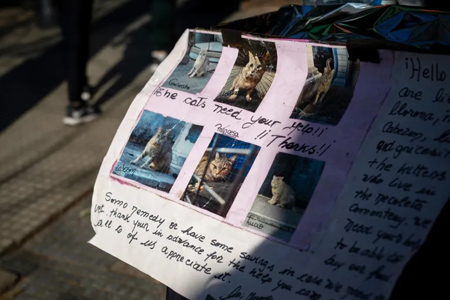
At the Recoleta Cemetery, Pisani relies on donations from tourists to pay for the remaining cats’ food and any medication they might need. Whenever new cats are abandoned at the cemetery, Pisani and others swiftly move to adopt them into a new home. The six Recoleta cats who are left, all of which have been fixed, will be the last of their kind.
“There’s going to come a moment where the Recoleta Cemetery will no longer have any cats,” he said. “That will be incredible.”
Pisani has placed posters and fundraising boxes on his flower stand. He relies on the donations to feed the cats [Maria Amasanti/Al Jazeera]
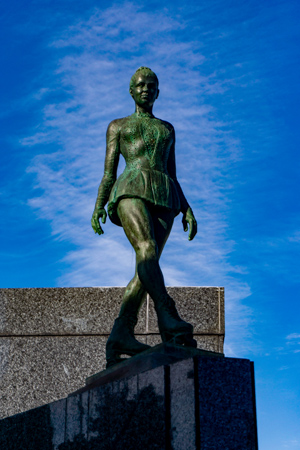
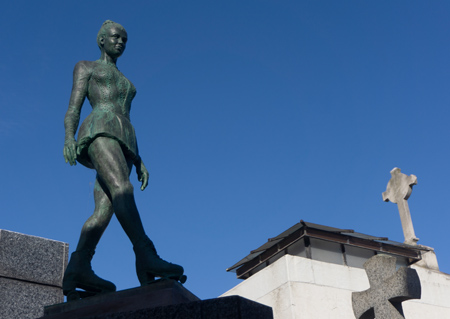
After a long time without major artistic additions, a new statue dazzles visitors to Recoleta Cemetery and has become a magnet for photographers. But unfortunately, a sad story accompanies the beautiful monument of a girl on roller skates.
Julieta was a young skater from Buenos Aires who spent time training at the GEBA (Gimnasia y Esgrima de Buenos Aires) and River Plate clubs. On 26 July 2018, two days before her 20th birthday, she died a sudden death… the exact cause has yet to be revealed by the family.
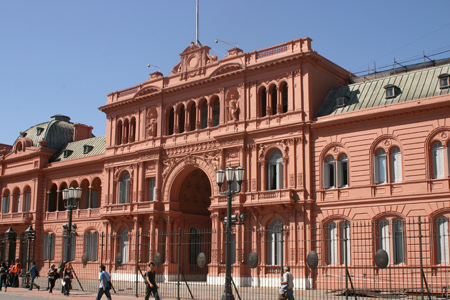
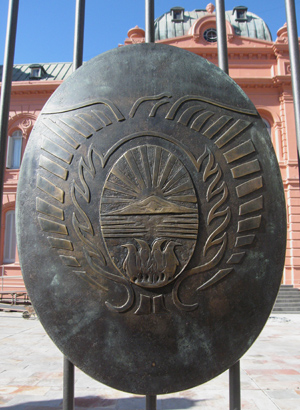
Initially buried in Chacarita Cemetery, a few months later in October 2018 Julieta was transferred to Recoleta Cemetery to a family vault in Section 6. The monument was inaugurated in April 2024, a 1.7 meter sculpture by the artist Jorge Luis Bianchi. Active since the 1980s, Bianchi is responsible for many works of art in Argentina including the provincial coats-of-arms that decorate a fence surrounding the Casa Rosada in Buenos Aires:
The GEBA club said goodbye to the young woman on 27 July 2018 with the following statement on Facebook:
“We regret to communicate the sad news of the death of Julieta Estévez, a skater for the River Plate Club who was also a GEBA skater. A girl full of life, projects, dreams and above all an excellent daughter, friend, partner and person. Our sincere condolences are with her family and friends at this painful moment, accompanying us with our prayers to ask for her eternal rest.
We will remember you forever Juli…❤”.
Marcelo thanks María Laje and Susana Gesualdi for information included in this post. Added to the Recoleta Cemetery map & guide in Jul 2024!