Posts about Art + Architecture

403. more reflections

29 Jul 2010

Familia Ovidio Giménez, Recoleta Cemetery

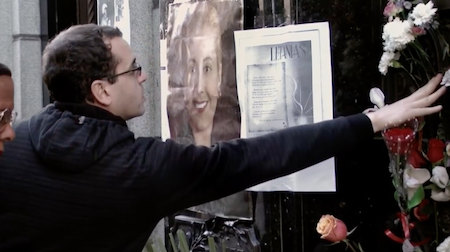
Found inside the Familia Ovidio Giménez-Ema Korek tomb. Previous reflection photos can be found here & here. Sally Blake (a.k.a. Sallycat) sent me a heads-up earlier this year about Julie-Anne Cosgrove who takes photos in the same vein.

399. manuel josé bustillo y su familia

08 Mar 2010

Alejandro Bustillo, Recoleta Cemetery

With a long history of military participation in Argentina, Bustillo family members saw action in the 1806 British invasion, the fight for independence under General José de San Martín, the struggle for national organization between Urquiza & Rosas, & the War of the Triple Alliance. But it was Alejandro Bustillo who made the most lasting contribution to Argentina as an architect for some of its largest cities.

Born in 1889, Alejandro graduated with a degree in architecture in 1914… no doubt inspired by his uncle, Eduardo Madero. His early works were mainly private dwellings but by the 1930s, Bustillo produced dozens of major buildings seemingly without stopping for breath.

Among some of his best known constructions are the hotel-casino in Mar del Plata (1938), headquarters for the Banco de la Nación in Buenos Aires (1940), & the cathedral & Hotel Llao Llao in Bariloche (1938-40). All are pictured below:

Mar del Plata, Bustillo

Banco de la Nación, Plaza de Mayo, Alejandro Bustillo

Catedral, Bariloche, Alejandro Bustillo

Hotel Llao Llao, Bariloche, Alejandro Bustillo

Bustillo claimed to be influenced by Albert Speer, chief architect for Hitler… evident in the scale of his larger works. Considered one of the great 20th-century architects of Argentina, Alejandro Bustillo passed away in 1982 at the age of 93.

The family tomb is the oldest in Recoleta Cemetery. At a time when graves were typically for individuals (remember Remedios de Escalada has the oldest single plot), the Bustillo family was one of the first to build a mausoleum. It dates from 1823, constructed only one year after the cemetery’s opening:

Alejandro Bustillo, Recoleta Cemetery

398. familia federico r. leloir ◊

05 Mar 2010

Luis Federico Leloir, Recoleta Cemetery

Family founder Federico Augusto Rufino Leloir Bernal possessed a large land fortune along the southern coast of the Buenos Aires Province. He & his wife traveled to Paris in 1906 for medical reasons, but unfortunately Federico passed away. One week later, Luis Federico was born… the last of five siblings.

Luis Federico Leloir without doubt became the most famous member of the family. His 1949 discoveries in biochemisty led to a Nobel Prize in 1970. Leloir & his team were the first to identify nucleotide sugars which are instrumental in accumulating energy stores in the human body:

UDP, Leloir

Ten years after his initial discovery, Leloir found that nucleotide sugars are responsible for transferring sugars to molecules which grow to an immense size & become glycogen… seemingly endless chains of glucose waiting to be broken down to provide energy:

glycogen molecule

As his studies progressed, Leloir proved that human biosynthesis is not merely a reversal of breakdown, as had been assumed earlier. On the contrary, they are distinct processes. Leloir’s principle was also shown to be valid with proteins and nucleic acids, leading to discoveries about organ donor rejection & lactose intolerance. Leloir passed away in 1987, five years after receiving a cross from the French Legion of Honor.

The family vault, built in 1906 with opulent Art Nouveau decoration, is one of the tallest in the cemetery:

Luis Federico Leloir, Recoleta Cemetery

What distinguishes the mausoleum are its mosaics. The underneath side of the dome is decorated with an image of Christ surrounded by angels. The mosaic can be seen from the interior of the mausoleum through a skylight… Christ appears dramatically overhead:

Luis Federico Leloir, Recoleta Cemetery

Luis Federico Leloir, Recoleta Cemetery

Luis Federico Leloir, Recoleta Cemetery

The interior is also lavishly decorated with mosaics & Art Nouveau imagery… press your nose to the glass for a look inside:

Luis Federico Leloir, Recoleta Cemetery

Leloir also has one other claim to fame:  the invention of a condiment. He came up with salsa golf at the Golf Club at the seaside resort of Mar del Plata. Basically a combination of mayonnaise & ketchup, it remains a popular, non-spicy alternative to cocktail sauce & a key ingredient of a local salad made with hearts of palm.

392. familia de luis a. huergo

19 Feb 2010

Luis Huergo, Recoleta Cemetery

Born in Buenos Aires in 1837, Luis Huergo completed his high school education in Maryland, USA then went on to become the first civil engineer to graduate from an Argentine university. He coordinated the construction of bridges throughout the Province of Buenos Aires with British assistance, built sections of new railroad, & improved the infrastructure of a growing nation.

Although he served as a Senator in the 1870′s as well as Dean of what eventually became the Engineering faculty, Huergo is most remembered for a project he never completed: a new cargo port for Buenos Aires. He had already deepened the exit for the shallow Riachuelo, allowing transatlantic liners to enter directly. It was only natural for Huergo to be part of a design contest for the new port.

Luis Huergo, Recoleta Cemetery

Huergo had some tough competition & an alternative plan was proposed by local merchant Eduardo Madero. Madero’s design was accepted over Huergo’s with ships entering through the southern canal, loading & unloading goods in any of four dykes, then exiting north. By the time Puerto Madero was inaugurated in 1897, it was obsolete. Madero’s design did not allow expansion of any kind… much needed when ships were growing larger & larger. Congestion was a considerable problem during Puerto Madero’s heydey with an amazing 32,000 embarkations made in 1910 alone:

Port designs, Luis Huergo & Eduardo Madero

To add capacity to Puerto Madero, Huergo’s design was reworked in 1907 & completed by 1919. The in-and-out design of Puerto Nuevo is more efficient & continues to function as the current port for Buenos Aires. All cruise & container ships dock there, & a gigantic plaque to Huergo highlights his biggest BA contribution:

Luis Huergo, Recoleta Cemetery

Luis Huergo, Recoleta Cemetery

Huergo’s son, Eduardo, also became an engineer & was responsible for the rectification of the Riachuelo. Those curves were replaced by a straight line in Eduardo beginning around 1927:

Eduardo Huergo, Recoleta Cemetery

At the age of 73, Luis Huergo formed part of a national commission dedicated to petroleum exploitation in Patagonia. He advocated government control to avoid the emergence of monopolies like Standard Oil while Dr. Pedro Arata, also part of the five-member board, thought private companies would be a better option. Huergo won in the end as the commission transformed into Yacimientos Petrolíferos Fiscales, remaining a state-run company until 1991. Huergo passed away in 1913 & left a legacy which remains apparent even 100 years after his death.

391. marco avellaneda ◊

17 Feb 2010

Marco Avellaneda, Recoleta Cemetery

386. luz maría garcía velloso ◊

05 Feb 2010

Luz María García Velloso, Recoleta Cemetery

Close to the entrance gate, the Art Nouveau effigy of Luz María García Velloso draws a lot of attention. Beautiful & in a highly visible location, it only seems natural that an urban legend would develop around her death.

Luz María García Velloso, Recoleta Cemetery

Supposedly a victim of leukemia at the age of 15, Luz María’s mom spent several  night vigils at the cemetery… actually sleeping inside the vault. Much later, men walking near Recoleta Cemetery reported an encounter with a young woman dressed completely in white. The most common version claims this woman would accompany them to a bar, get a chill then ask to borrow her date’s jacket. Next she would accidentally stain it with whatever they were drinking & take the jacket with her when they said goodnight.

The following day the man somehow contacts her mother to get the jacket back, & she explains that the young woman is already dead! In desperation, he goes to the cemetery & finds his jacket draped over the effigy. While none of the above has been confirmed, it makes for an interesting story… probably one of the most common urban legends in the world.

Luz María García Velloso, Recoleta Cemetery

Fortunately some factual information about the rest of the family—also buried here—is available. Luz María’s father, Enrique García Velloso, was of Basque descent & heavily involved in the arts at the beginning of the 20th century in Buenos Aires. He directed the first movie version of Amália by José Marmol in 1914. Two years later he wrote Mamá Culepina about the barracks following the troops of Lucio V. Mansilla.

Enrique García Velloso, Recoleta Cemetery

All this artistic activity led Enrique to be named the first President of the Casa del Teatro—an actors association/retirement organization based on Avenida Santa Fe. Still possessing a popular theater,  the fantastic Art Deco building was designed by Alejandro Virasoro… the same architect who built the Defferrari family vault.

Enrique’s cultural connections expressed their sorrow for the death of Luz María with poetic plaques on the left side of the family vault:

Luz María García Velloso, Recoleta Cemetery

Unfortunately the elaborate interior painting is missing these days, but the ceiling’s stained glass remains intact:

Luz María García Velloso, Recoleta Cemetery

Second to last photo courtesy of the Archivo General de la Nación.

Last photo can be viewed larger in Flickr.