Posts about Sports

493. martín karadagián

11 Feb 2013

Recoleta Cemetery, Buenos Aires, Martín Karadagián

Born in Buenos Aires in 1922, Karadagián used his father’s heritage for a nickname in the professional wrestling world: the Armenian. After retiring from Greco-Roman wrestling, he switched to acting… playing a wrestler down on his luck in the 1957 film “Reencuentro con la gloria.”

These two worlds would come together when Karadagián began the tv show Titanes en el Ring in 1962. Similar to what Americans recognize as the World Wrestling Federation, Karadagián occasionally fought but often kept to the role of announcer. The show remained on the air until 1988, & Karadagián passed away a few years later in 1991.

Recoleta Cemetery, Buenos Aires, Martín Karadagián

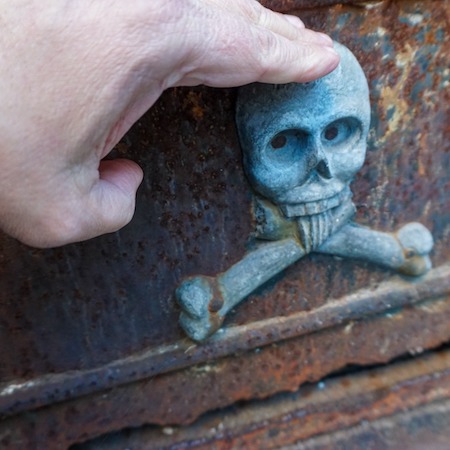
Although there is little to identify his tomb, two bronze plaques express sorrow at Karadagián’s departure. These type of plaques are more often found in Chacarita Cemetery, so they are even more endearing here. A peek inside shows the wrestler with his unmistakeable haircut:

Recoleta Cemetery, Buenos Aires, Martín Karadagián

465. manuel d’huicque y familia

22 Apr 2012

Recoleta Cemetery, Buenos Aires, Manuel d'Huicque

The first Manuel d’Huicque came from France & imported coffee from Brazil. Although several establishments were located in Buenos Aires, perhaps the most famous was Café La Brasileña located along the old Rambla of Mar del Plata. Apparently his son (“h”=hijo) had a fondness for sportscars!

269. familia menditeguy

12 Dec 2008

Carlos Menditeguy, Recoleta Cemetery

Carlos Menditeguy, sportsman & reknowned playboy, embodied Argentina’s growing role in world affairs in the 1950s. He did it all & did it well, becoming one of the top 6 polo players in the world & often seen in the Argentine Grand Prix. His skill & performance made Maserati take note, & they offered him an opportunity to race on behalf of the company in Europe. Menditeguy’s most significant Formula One race earned him third place while driving a Maserati 250F in 1957. He was notoriously hard to work with & demanding on his equipment but loved the risk involved. Menditeguy passed away in 1973.

Even though the family vault is far from the main walkways of the cemetery, Carlos obviously wanted a permanent stage presence. The northern façade contains a large glass panel providing the visitor an easy look at the elaborate altar & his casket… which will never be moved to underground storage:

Carlos Menditeguy, Recoleta Cemetery

A stained glass panel in the rear of the vault depicts Santiago Matamoros, patron saint of Spain. Not in the least bit politically correct, St. James supposedly helped Spaniards through 800 years of territorial reconquest as they slowly pushed the Moors back to North Africa. Translated as St. James the Moor Slayer, the stained glass depicts him wielding a sword with several Moors being trampled by his horse:

Santiago Matamoros, Carlos Menditeguy, Recoleta Cemetery

257. urbano domecq

29 Sep 2008

Urbano Domecq, Recoleta Cemetery

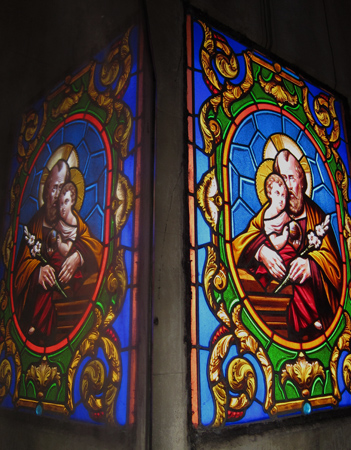
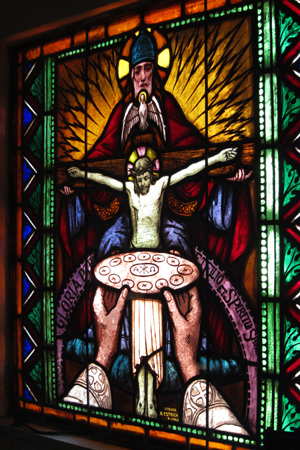
Usually lost in the shadows, the Urbano Domecq vault contains one of the few references in the cemetery to the upper-class sport of polo. Gaining popularity during the 1920s & 1930s, matches would draw crowds of over 25,000 people to the Campo Argentino de Polo in Buenos Aires. At the same time, creation of the prestigious Cup of the Americas tournament gave world-wide recognition to Argentine polo players. Adolfo certainly liked the game with plaques from two different clubs where he played:

Urbano Domecq, Recoleta Cemetery

Urbano Domecq, Recoleta Cemetery

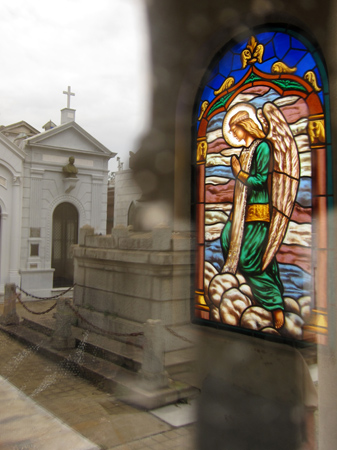
The interior contains three panels of stained glass:

Urbano Domecq, Recoleta Cemetery

213. sepulcro de antonio martínez

24 Jun 2008

Ángel María Zuloaga, Recoleta Cemetery

Neglected & forgotten, the final resting place of Ángel María Zuloaga remains unnoticed by most. A few plaques alert to his skill in aviation, but only one mentions Zuloaga’s 1916 record-breaking trip across the Andes by hot air balloon with Eduardo Bradley:

Ángel María Zuloaga, Recoleta Cemetery

Quite a personality in his own right & not a mere sidekick to Bradley, Zuloaga traveled the world & was considered an expert in aeronautics. In his 20s, Zuloaga served as military attaché to France during World War I & later spent time in Washington, DC as a military advisor. He could have even been the first to cross the Atlantic by plane, but the Argentine government failed to back Zuloaga’s request for assistance three years before Lindbergh’s historic flight. Foreign Minister Bernardo de Irigoyen told Zuloaga, “If man was meant to fly, God would have given him wings.” At this point, Zuloaga had to choose between his Air Force career or going it alone across the Atlantic… he remained in the military.

His youngest daughter described him as “loving but disciplined” & fondly remembered his great love of art & friendships with Benito Quinquela Martín & Luis Perlotti. During a visit to Europe as World War II began, Zuloaga was invited to speak with Hitler but refused to go. He was, however, on friendly terms with Franco. Zuloaga added to his legacy by penning a history of Argentine aviation in 1948 titled “La Victoria de las Alas.” At present, I’ve been unable to determine how Zuloaga was buried here but I’m assuming that the Martínez family was related to his wife in some way. Any further info would be appreciated.

168. eduardo bradley

30 Mar 2008

Eduardo Bradley, Recoleta Cemetery

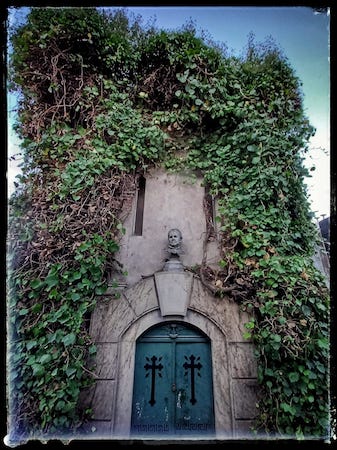
With no nameplate on the skinny vault & stuck in the middle of a narrow corridor, it’s easy to miss one of the greats of Argentine aviation.

Coming from a long line of Irish-American intermarriage in Argentina, Eduardo Bradley was born in the city of La Plata in 1887. His fascination for the sport of aeronautics led him to become friends with Argentina’s first & foremost aviator, Jorge Newbery.

Newbery died in an attempt to cross the Andes by plane in 1914, but two years later Bradley made it… not by plane but by hot-air balloon. No small feat for the time. The Andes are the second tallest mountain chain on Earth after the Himalayas, & temperatures reached a low of -34ºF during Bradley’s trip. He & co-pilot Ángel María Zuloaga departed from Santiago de Chile & landed in Mendoza in 1916.

Plaques from 1966—commemorating the 50th anniversary of Bradley’s flight—are the only reminder left. Most people have no idea who Bradley is today. He passed away in 1951.

Eduardo Bradley, Recoleta Cemetery

Eduardo Bradley, Recoleta Cemetery